





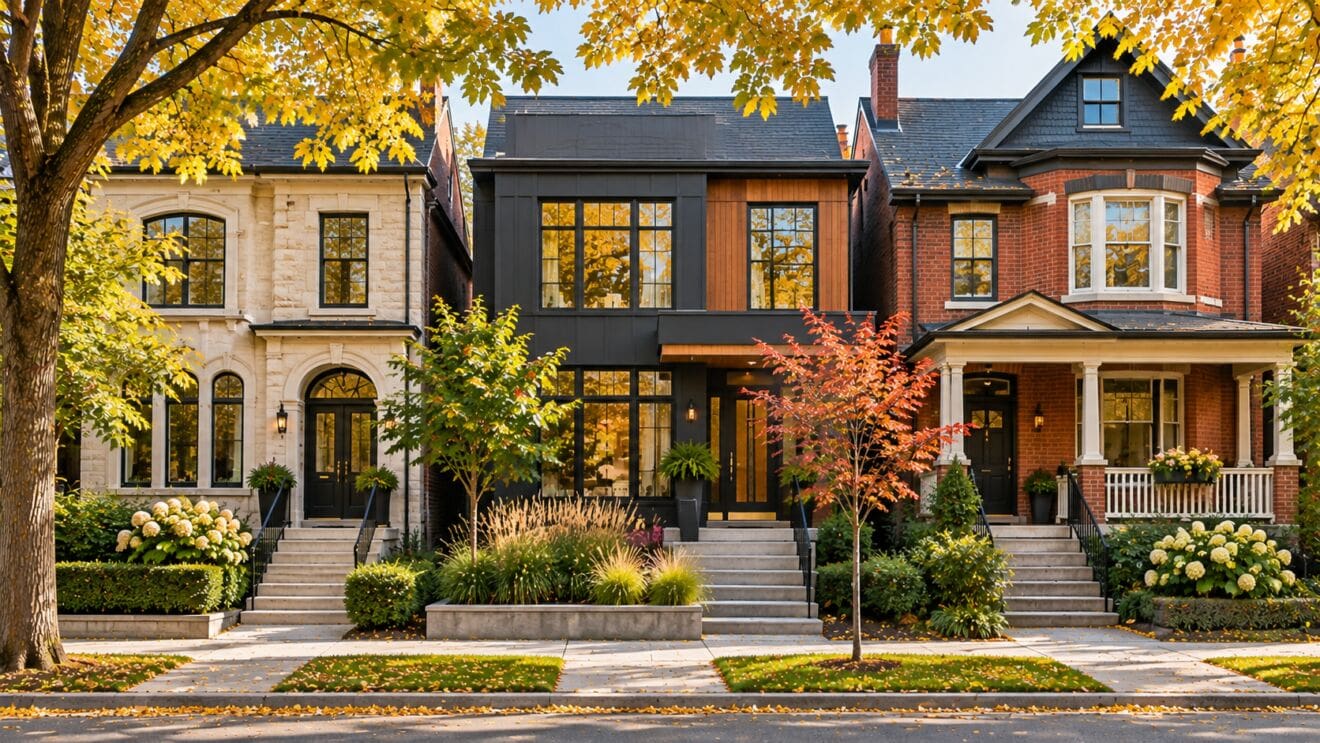
What if a softer real estate market actually made it easier to move into a better home?
It’s not how most homeowners think about the market.
When prices fall, the immediate reaction is usually concern about what their current property might be worth. And I understand that.
But if you’re thinking about selling one home and buying another, there’s a much more important number I’d encourage you to consider.
The difference between what you’re selling and what you’re buying.
As we head toward 2027, I believe that difference could create some of the most interesting opportunities we’ve seen in Toronto real estate in years.
And it’s one of the central themes in my newly released 2027 Toronto Real Estate Market Outlook & Predictions.
Not Every Toronto Housing Market Is Moving Together
If there’s one thing 2026 has reinforced, it’s that Toronto isn’t one real estate market.
Condos are behaving differently from semi-detached homes. Semi-detached homes are behaving differently from detached properties. And even within the detached market, a $2 million family home and a $5 million luxury property can face completely different conditions.
That’s important because homeowners considering a move are often participating in two markets simultaneously.
The market they’re selling in and the market they’re buying in.
And those markets don’t necessarily move at the same pace.
The Opportunity Hiding in the Price Difference
Imagine you own a semi-detached home and want to move into a detached property.
In an earlier market, your semi might have been worth $1.4 million, while the detached home you wanted cost $2.2 million.
That’s an $800,000 difference.
Now imagine conditions have changed.
Your semi is worth $1.3 million.
The detached property is available for $1.9 million.
Your current home has lost $100,000 in value.
But the home you’re buying has become $300,000 less expensive.
The difference between the two properties has narrowed from $800,000 to $600,000.
That’s a $200,000 improvement in the price gap.
Of course, this is a hypothetical illustration, not a valuation of actual Toronto properties. Transaction costs, financing and carrying expenses also need to be considered.
But it demonstrates something I think homeowners often overlook.
You don’t necessarily need your current home to appreciate to make a financially attractive move.
Sometimes the opportunity is in what happens to the property you’re buying.
Explore the Bigger Picture for 2027
This is just one of the opportunities I’m watching as we head into 2027.
In my new 2027 Toronto Real Estate Market Outlook & Predictions, I explore five predictions for the year ahead, including which housing segments I expect to perform best and what that could mean for your next move.
Explore My 2027 Toronto Real Estate Predictions
Why I’m Watching Semi-Detached and Detached Homes So Closely
In my 2027 Market Outlook, I identify semi-detached and row houses as one of the segments with the strongest potential for price growth.
These homes remain difficult to replace in established Toronto neighbourhoods.
For many buyers, they offer the right combination of location, usable space, outdoor areas and access to neighbourhood amenities.
Detached homes, meanwhile, may present a different set of opportunities.
In certain price ranges, buyers have more choice and greater room to negotiate.
And at the luxury end of the market, I expect conditions to remain more favourable to buyers.
This creates an interesting possibility for someone selling a desirable semi-detached home and purchasing a larger detached property.
You could be selling into a relatively competitive market while buying into a more balanced one.
That isn’t guaranteed, of course.
Every neighbourhood and property is different.
But it’s exactly the kind of relationship I’d want to investigate before deciding whether to move in 2027.
Waiting for Your Home to Recover Might Not Be the Best Strategy
This is where I think some homeowners could make a costly assumption.
They decide to wait until their current home returns to its previous peak value before considering a move.
But what happens if the detached property they want also becomes more expensive during that time?
They may recover $100,000 on their sale while paying an additional $200,000 for their next home.
Suddenly, waiting hasn’t improved their position.
It’s made the move more expensive.
That’s why I don’t believe the right question is simply:
“When will my home be worth more?”
It’s:
“What will the entire move cost me, and how might that change?”
That requires looking at both sides of the transaction together.
What Else Am I Predicting for Toronto in 2027?
The move-up opportunity is just one of five major predictions I’ve outlined in my new Market Outlook.
I’m also watching the potential cost of waiting for buyers, the widening differences within Toronto’s detached market, the relative strength of semis and rowhomes, and the growing divide between condos designed for living and those designed primarily for investment.
I’ve included my property-type price forecasts, the market signals I’ll be monitoring and, most importantly, what I believe buyers, sellers and homeowners should actually do with this information.
Because predicting where the market might go is one thing.
Knowing how to use that information to make a better decision is another.
Get My 2027 Toronto Real Estate Market Outlook & Predictions
Where could Toronto home prices go in 2027? Which housing segments may offer the strongest opportunities? And what should buyers, sellers and homeowners be thinking about now?
I’ve put together a complimentary guide covering my five predictions, property-type price forecasts and the market signals I’ll be watching as we head into the new year.
Download the Complimentary 2027 Market Guide
My Take
I think 2027 could be a particularly interesting year for Toronto homeowners considering their next move.
Not because I expect every property type to suddenly take off.
Quite the opposite.
The opportunity may come from the fact that different parts of the market are moving at different speeds.
For some homeowners, that could mean selling a property with relatively strong demand and purchasing one where buyers still have meaningful negotiating power.
For others, the right decision may be to prepare now and wait for a more favourable opportunity.
The key is understanding the numbers that apply to your situation.
Because the best real estate decisions aren’t necessarily made when the entire market is rising.
They’re made when you recognize an opportunity that makes sense for you.
And sometimes, that opportunity is hiding in the difference between two prices.

TRB Education Hub
Get the real estate resources you need to succeed. Visit our education hub for market insights, guides, podcasts and more.