



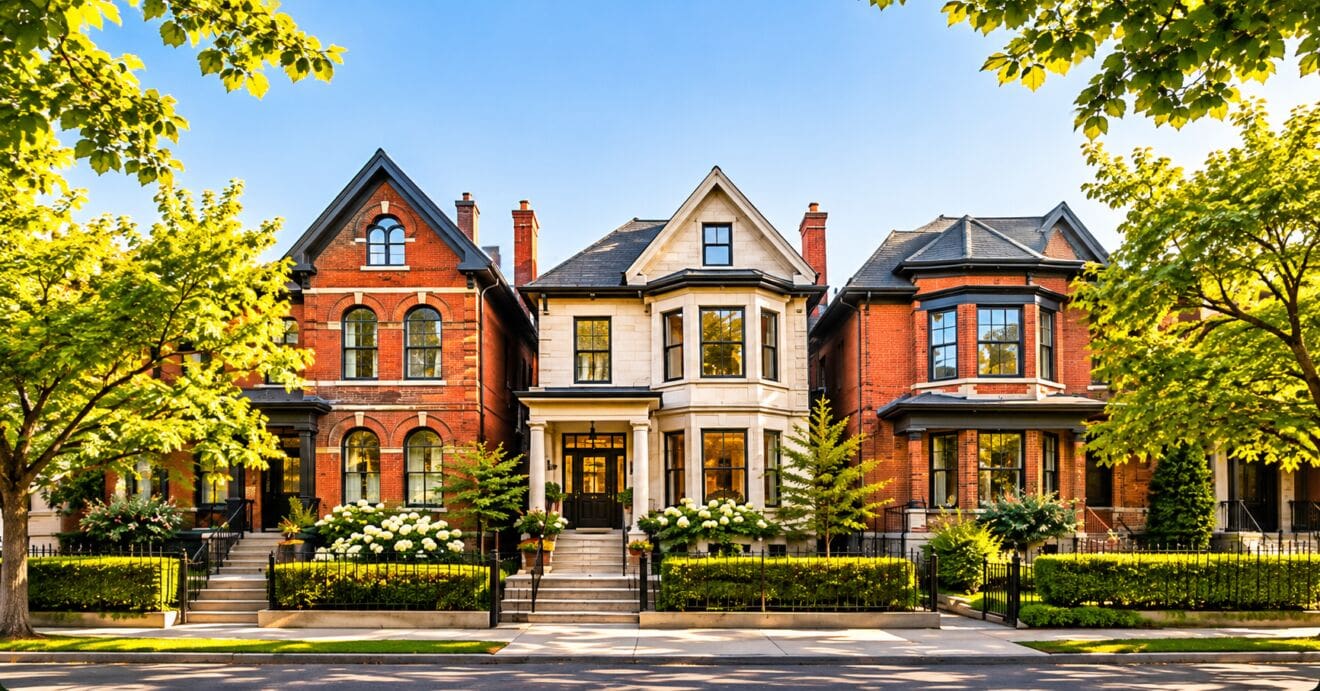
If you’ve been following the real estate headlines lately, you’d be forgiven for thinking Toronto’s housing market is moving in one direction.
Sales are falling. Buyers are hesitant. Prices are under pressure.
And depending on which headline you read, the outlook can sound pretty discouraging.
But here’s what I think is missing from that conversation: Toronto isn’t one real estate market. And the GTA certainly isn’t.
A condo in King West doesn’t compete with a detached home in Brampton.
A semi-detached home in Leslieville doesn’t necessarily respond to the same conditions as a luxury detached property in Rosedale.
Yet we routinely blend all of those properties into one enormous set of statistics and try to draw conclusions about what the market is doing.
That’s why I prefer looking at Toronto’s individual housing segments.
And October revealed something worth paying attention to.
Even as sales remain relatively subdued, the number of homes coming onto the market is declining.
That doesn’t mean every segment is suddenly becoming competitive.
But it does mean the balance between buyers and sellers deserves a closer look as we head toward 2027.
The Number I’m Watching Isn’t Just Sales
Across the City of Toronto, October sales were approximately 7% lower than a year earlier. But new listings were down roughly 9%. That’s an important distinction.
When sales fall, the natural assumption is that the market is weakening. But if fewer properties are also coming onto the market, the relationship between supply and demand can change.
In October, Toronto had 5,451 new listings compared with 5,993 a year earlier.
And the number of properties available for sale at month-end was also lower than last October.
We’re not looking at a sudden return to a seller’s market. We’re looking at a market where supply is adjusting alongside demand.
And the impact is different depending on what you own—or what you’re hoping to buy.
Condos: Buyers Are Becoming More Selective
Toronto condo apartments averaged approximately $659,000 in October, down about 6% compared with last year.
Sales were also lower. But new listings declined, too. That doesn’t mean the condo market has suddenly turned around.
There is still meaningful choice for buyers, particularly among smaller suites.
What interests me more is how buyer preferences are evolving.
I’m seeing greater emphasis on functional space. Real bedrooms with proper closets. Dens that can genuinely function as offices. Living rooms that accommodate actual furniture. Storage. Natural light. Layouts that make sense for everyday living.
Buyers aren’t simply asking how much square footage they’re getting.
They’re asking how comfortably they can live in it.
And I think that’s creating an increasingly important distinction within the condo market.
A well-designed two-bedroom condo and a compact investor-oriented suite are not necessarily competing for the same buyer.
For homeowners considering a move into a larger condo, this is particularly interesting.
The market may offer an opportunity to upgrade into a more functional property while prices remain under pressure.
But the economics depend on what you’re selling, what you’re buying and how much competition exists in each segment.
I wouldn’t assume all condos will recover at the same pace.
And I certainly wouldn’t buy one based solely on the expectation that prices must eventually return to their previous highs.
Detached Homes: A More Stable Picture
Toronto detached homes averaged approximately $1.6 million in October, with prices relatively close to where they were a year ago.
Sales were also broadly stable. New listings, however, were lower. To me, that’s a more nuanced picture than the broader GTA headlines suggest.
Detached homes haven’t suddenly entered another period of dramatic price growth.
But neither does the Toronto data suggest that every detached seller is facing a collapsing market.
What matters is the property itself. The neighbourhood. The price point. The condition. The competition. And whether the asking price reflects what today’s buyers are actually willing to pay.
For move-up buyers, this is a segment I’d be investigating carefully.
There are still opportunities to negotiate, particularly when a property has been sitting or a seller’s expectations haven’t adjusted to current conditions.
But those opportunities aren’t universal.
A well-positioned detached home in a neighbourhood with limited competition can behave very differently from an overpriced property just a few streets away.
Semi-Detached Homes: Why I Keep Coming Back To This Segment
Semi-detached homes remain one of the segments I find most interesting in Toronto.
October prices were essentially unchanged from last year, with a modest increase in sales.
And while the citywide number of new semi-detached listings was slightly higher year over year, the amount of available inventory remains important to evaluate at the neighbourhood level.
Because buyers shopping for semis are often looking for something very specific.
A family-friendly street. Three proper bedrooms. Parking. Outdoor space. A functional main floor. Access to schools, transit and neighbourhood amenities.
In many established Toronto neighbourhoods, the supply of homes meeting those criteria is naturally limited.
And when the right property becomes available, it can attract a very different response from the broader market.
That doesn’t mean every semi-detached home is going to appreciate.
It means we need to pay close attention to the properties buyers consistently want and how many genuine alternatives they have.
Scarcity matters most when it’s attached to something buyers actually value.
The Move-Up Opportunity Heading Into 2027
Here’s where I think the differences between housing segments become particularly useful.
Imagine you own a semi-detached home and have been thinking about moving into a detached property.
Your sale and your purchase involve two different markets.
The buyer pool for your semi may be relatively deep in your neighbourhood.
Meanwhile, the detached properties you’re considering may have more competition among sellers, longer selling times or greater negotiating flexibility.
If those conditions exist, the move could be more attractive than simply looking at whether Toronto prices are rising or falling.
But I’d want to do the math before making that assumption.
What could your current home realistically sell for?
What would you need to spend on the detached property?
How much is the difference?
What are the land transfer taxes, moving expenses and carrying costs?
And perhaps most importantly: Should you sell first or buy first?
That’s the conversation I’d be having now with homeowners who are considering a move in 2027.
Not because I think everyone should rush to move.
Because understanding the relationship between the two markets before spring arrives can create a much better strategy.
Why I Wouldn’t Wait For A Perfect Market
There’s a tendency in real estate to wait for some unmistakable signal.
Buyers want to know when prices have reached the bottom.
Sellers want to know when the market has fully recovered.
Move-up buyers want the perfect moment when their current home is worth more but the next one is still a bargain.
Unfortunately, markets rarely provide that kind of clarity in real time.
And when they do, everyone else usually sees it too.
I’d rather focus on the conditions that actually affect the decision.
What is the competition like in the neighbourhood you’re selling in?
How motivated are sellers in the segment you’re buying?
How much negotiating room exists?
What will the entire move cost?
And how does that compare with waiting another six or twelve months?
Those are questions we can investigate.
Predicting exactly where the market will be next spring is much harder.
My Take
The biggest story in October isn’t simply that GTA home sales were lower.
It’s that the supply of homes is also changing—and that Toronto’s housing segments aren’t all responding in the same way.
Condo buyers still have meaningful opportunities.
Detached homes are showing a degree of stability.
And well-located, desirable semi-detached homes remain a segment worth watching closely.
For homeowners considering a move-up purchase, the relationship between those markets may be more important than the overall direction of Toronto prices.
That’s why I don’t believe in making real estate decisions based on one headline.
The question isn’t simply whether the market is going up or down.
It’s whether the conditions in the market you’re selling into—and the one you’re buying into—create an opportunity worth pursuing.
Because my job isn’t just to tell you what the market is doing. It’s to help you understand what it means for your next decision.
If you’re considering buying, selling or moving up in 2027, the best place to start is with a strategy built around your specific property, your next purchase and your timing.
Thinking about making a move in 2027? Let’s build your move strategy.

TRB Education Hub
Get the real estate resources you need to succeed. Visit our education hub for market insights, guides, podcasts and more.